The Native Plants from the Mountains
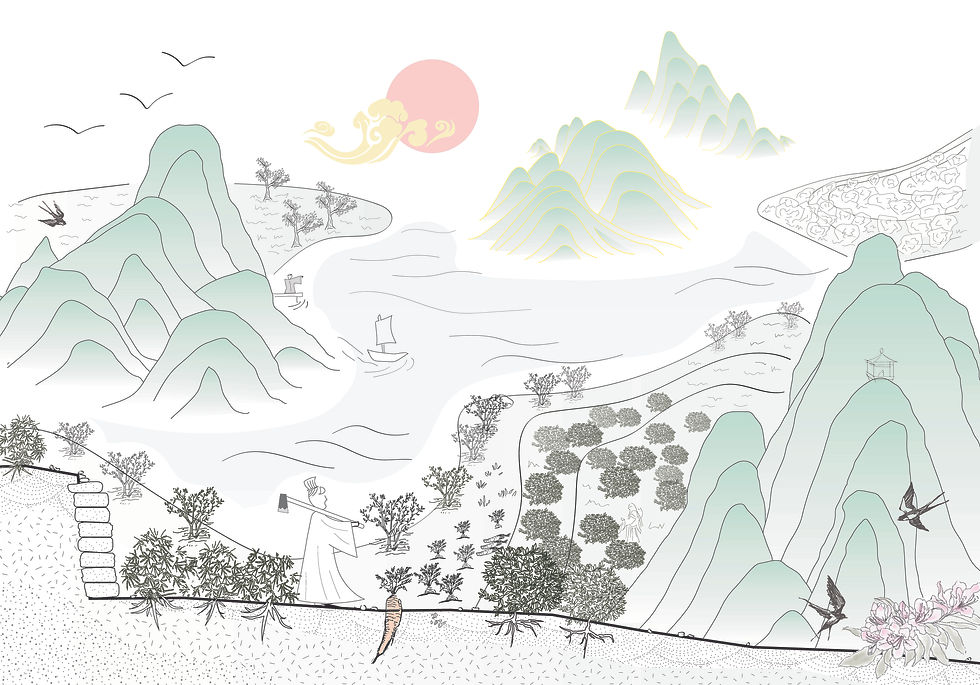
Mist drifts between the mountains of a small village, where terraces hold soil like open hands and the river carries memory more than water. A scholar walks along a narrow path, brushing past tea leaves—cha—whose name is spoken softly, as if it belongs to the breath itself. Nearby, a farmer bends over rows of carrots—huluobo—pulling orange roots from dark earth, while a healer gathers hemp—ma—and a child points toward blooming dujuan on the hillside. In this landscape, plants are not specimens. They are companions, each known through touch, taste, labor, and story. But another language begins to arrive, not on the wind but in books carried across oceans. The plants are renamed.
Tea becomes Camellia sinensis. The name is precise, structured, and foreign to the rhythms of the village. It does not carry the sound of boiling water, the gesture of pouring, or the quiet philosophy of drinking.
On the mountainside, dujuan blooms in bursts of red and pink, signaling seasons and stirring poetry. Yet it, too, is renamed: Rhododendron. A word that travels well across European tongues, cataloged in botanical gardens, admired as an exotic ornamental. The flower is detached from the hillside, from the poems it once inspired, and from the ecological web that gave it meaning.
In the fields, huluobo—the “foreign radish”—already carries a history of movement, of adaptation across regions. But under Latin naming, it becomes Daucus carota, stabilized and standardized. Its variability is reduced; its story flattened. What was once a marker of exchange becomes an object of agricultural control.
And ma, the versatile hemp plant, shifts most dramatically. Known in the village as fiber, medicine, and ritual material, it is redefined as Cannabis sativa. Under this name, it enters legal and scientific systems that isolate one aspect—its psychoactive properties—while obscuring its broader cultural roles. Regulation follows naming, and the plant’s identity narrows.
In one world, plants belong to landscapes—to mountains, rivers, and people. In the other, they belong to systems—to herbaria, empires, and markets.
Yet the village does not forget. The farmer still says cha. The healer still gathers ma. The child still learns dujuan when the hills bloom. Latin names exist, but they do not fully replace what is rooted here.
As the sun sets behind layered peaks, the river continues its quiet flow. It carries no Latin, no taxonomy—only reflections of a world where naming is not an act of possession but of relationship.
References
Anderson, E. N. (1988). The food of China. Yale University Press.
Clarke, R. C., & Merlin, M. D. (2013). Cannabis: Evolution and ethnobotany. University of California Press.
Reid, D. P. (2011). The art and alchemy of Chinese tea. Singing Dragon.
Wu, Z. Y., Raven, P. H., & Hong, D. Y. (Eds.). (1994–2013). Flora of China (Vols. 1–25). Science Press & Missouri Botanical Garden Press.
Ye, X. (2003). On the symbolic significance of Chinese garden plants. Journal of the Oriental Society of Australia, 35, 20–37.
萝卜 Luobo
Radish
The radish is one of the world's most ancient cultivated crops, distributed primarily across the European continent, North Africa, Central Asia, Japan, and China. According to historical records, the wild progenitor of the radish was found in wild varieties along the temperate coastlines of Europe and Asia. Based on available evidence, agricultural historians estimate that the consumption of radishes by the ancient Chinese dates back some 6,000 to 7,000 years. Over the five-to-six-century span from the Western Zhou through the Spring and Autumn periods, radish cultivation in China was concentrated in the middle and lower reaches of the Yellow River basin.
The Yuan Dynasty poet Xu Youren’s lines—"Cooked, it is as sweet as taro; raw, it is as crisp as a pear"—describe the texture of the radish, conveying his appreciation and praise for its delightful crispness.
Cultural and Spiritual Significance
In Chinese culture, radish (萝卜) and carrot (胡萝卜) both have value as food and medicine, but radish holds deeper cultural and spiritual significance. Radish is strongly connected to traditional beliefs about health, seasonal balance, and good fortune. In some southern regions, it is called 菜头(Caitou), which sounds similar to phrases associated with good luck and a good beginning, making it common in Lunar New Year meals and festival traditions. Traditional Chinese medicine also values radish for aiding digestion, moving qi, and restoring balance in the body, reflecting the belief that food supports harmony between humans and nature. Carrot, introduced later to China through trade routes, has less symbolic meaning but is valued for its nutritional and medicinal qualities. It is associated with health, nourishment, and food therapy, especially for strengthening the body and supporting eyesight.
Plant Drawing


灰柳 Huiliu
Grey Willow
Grey sallow (Salix cinerea) is considered the most invasive type of willow in Australia. Unlike other willows, it can produce masses of viable seeds that travel great distances and establish quickly. Wild populations were first discovered in Tasmania about 20 years ago, and while dedicated control efforts have so far kept it from becoming widespread, it may only take one season with optimal conditions for grey sallow to become uncontrollable.
Salix is the botanical genus name for willows, sallows, and osiers, comprising approximately 350–400 species of deciduous trees and shrubs in the family Salicaceae. Originating from Latin, the term refers specifically to the willow tree.
Culturally, grey willow has been valued as a practical material and a source of traditional knowledge. Its flexible stems made it suitable for weaving simple baskets, fencing, and agricultural structures, similar to uses observed in related species such as Salix viminalis. Beyond its bark, which contains salicin, historically used in herbal medicine to treat pain and fever, linking it to early medicinal practices that informed modern pharmaceuticals. In managed landscapes, grey willow was often planted intentionally along riverbanks and wetlands, functioning as a form of living infrastructure. Rather than engineered solutions, communities relied on these trees to stabilize soil, manage water flow, and protect agricultural land, demonstrating a long-standing integration of ecological processes into cultural practices.
However, as depicted by the grey willow as an "invasive plant". People's attitudes towards these valuable plants are negatively impacted. We should not ignore the coronial displacement of native plants from different continents and environments. We should be aware that each plant has an original ecosystem it belongs to.
Cultural and Spiritual Significance

甘蔗 Ganzhe
Sugar Cane
Sugar cane, scientifically known as Saccharum officinarum, holds a far more globally entangled cultural history than grey willow, stretching across tropical regions from Southeast Asia to the Caribbean and the Americas. Its Indigenous origins trace back to New Guinea and surrounding areas, where early communities domesticated it for its sweet juice long before industrial sugar existed. Across cultures, sugar cane carries many local names, often tied to sweetness, vitality, and fertility. In India, for example, it appears in religious rituals and festivals, symbolizing prosperity and life energy, while in parts of Southeast Asia it is chewed fresh as both food and refreshment, a direct, unprocessed relationship with the plant.
Culturally, sugar cane has been both a gift and a burden. On one hand, it is deeply embedded in food traditions, from raw chewing cane to jaggery, molasses, and refined sugar, shaping cuisines and social rituals worldwide. On the other hand, its cultivation is inseparable from the history of colonialism and the transatlantic slave trade, particularly in plantation systems across the Caribbean and the Americas. Sugar cane fields became sites of forced labor and exploitation, making the plant a symbol of both abundance and historical trauma. This dual identity continues to influence how sugar is perceived today, as something ordinary yet historically charged.
Papuans may have started cultivating sugarcane as early as 8000 BC, although they may have initially only eaten the grassy leaves at the top of the sugarcane plant, using the main stem for building houses and rafts. They then introduced sugarcane to Polynesia, the islands of Southeast Asia, and as far as Madagascar. It was introduced to China and India around 1200 BC. During Alexander the Great's conquest of India, one of his generals mentioned that India produced a type of grass that produced honey without the need for bees. In the 6th century, Khosrau I Anushirvan, the king of the Sasanian Empire of Persia, introduced sugarcane cultivation to Iran. From the 8th to the 10th centuries, sugarcane cultivation spread throughout Iraq, Egypt, Sicily, and the Iberian Peninsula. Later, Portuguese and Spanish colonists brought sugarcane to the Americas and cultivated it extensively in South America.
Cultural and Spiritual Significance


麻 Ma
Cannabis / Hemp
The simplified scientific name for Cannabis sativa was given by Carl Linnaeus in 1753. The word “sativa” means “cultivated, " indicating that this plant has been cultivated by humans for a long time. The name "Cannabis" comes from the ancient Greek word kánnabis. “Hemp” (industrial hemp) comes from the Old English word hænep. These names predate the modern colonial period.
In scientific classification and knowledge, Linnaeus used the Latin binomial nomenclature to unify cannabis from different regions under the name Cannabis sativa. This classification method facilitates scientific research but also simplifies the local planting knowledge and naming systems that have long existed in various regions.
Cultural and Spiritual Significance
Cultivation in China and Asia: In China, hemp is called "ma" and is also known as "hanma," "xima," "juma," "dama," etc. It is used for fibers, as well as in food and traditional Chinese medicine. Hemp seeds (cannabis seeds) are often used to treat digestive problems and can also be pressed for oil for consumption.
Colonialism and the Influence of Power (Simplified Understanding): The European scientific system has become the global standard, resulting in less emphasis on local knowledge in international botany. Plant naming is not only a scientific activity but also related to culture and power.
Modern legal changes mean that industrial hemp (THC content below 0. 0.3%) is now legally cultivated as an economic crop in many countries. However, in the 20th century, international drug control laws (such as the relevant convention of 1961) classified all cannabis as a drug, ignoring the distinction between fiber cannabis and hallucinogenic uses, which has impacted traditional uses and certain social groups.


桂花 Guihua
Osmanthus
Osmanthus fragrans (lit. 'fragrant osmanthus') is a flowering plant in the family Oleaceae. In English, it is sometimes called sweet osmanthus, sweet olive, tea olive, or fragrant olive. It is native to Assam, Cambodia, China, the Himalayas, Hainan, Japan, Myanmar, Taiwan, Nepal, Thailand, and Vietnam.
The genus name Osmanthus is composed of two Greek etymons: "οσμη" (osme), meaning "smell," and "ανθος" (anthos), meaning "flower." The specific name fragrans is a borrowing from Latin, meaning "odorous, fragrant," referring to the intense fragrance of its flowers.
Cultural and Spiritual Significance
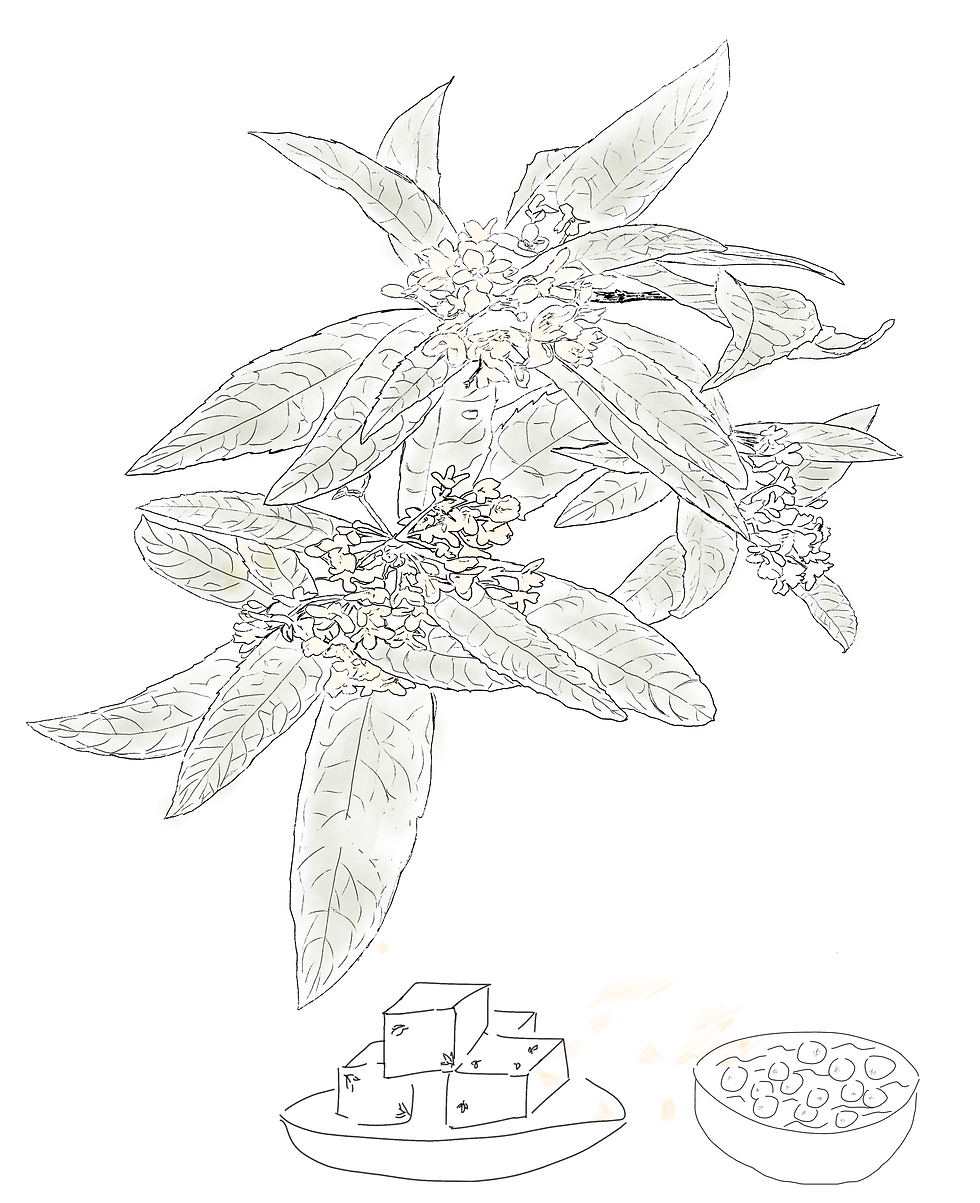
Blooming in early autumn, its scent marks a subtle shift in time, often aligning with the Mid-Autumn Festival. In this context, osmanthus is not just a plant but a temporal signal, a botanical calendar that announces reunion, harvest, and reflection. Its flowers are used in teas, wines, and sweets, embedding it into daily life as something both sensory and ceremonial.
The spiritual life of guihua (桂花), or Osmanthus fragrans, drifts less through doctrine and more through sensation. Its fragrance arrives quietly, often before the flowers are even seen, like a presence that announces itself without spectacle. In Chinese cultural thought, this subtlety becomes a virtue. Guihua also carries connotations of achievement and transcendence. Historically, the word gui (桂) is a homophone for “honor” or “nobility” in certain contexts, and thus the flower became associated with success in imperial examinations. To “pluck osmanthus from the moon” was a poetic way of describing the attainment of scholarly distinction, suggesting not just success, but success touched by something higher, almost celestial. Spiritually, this ties the plant to aspiration, not as ambition in a modern sense, but as alignment with harmony, discipline, and timing. The fragrance becomes a metaphor for virtue: something cultivated internally that naturally radiates outward.
Plant Drawing
茶 Cha
Tea
Tea, from the plant Camellia sinensis, carries a name that has traveled like a tide, reshaped by language, trade, and power. In Min Nan dialects of southeastern China, it is called te, a sound that sailed outward along maritime routes and became “tea” in English, while inland pathways carried variants like cha across Asia. Other regional names reveal different relationships to the plant, such as the Burmese lakphak, referring specifically to fermented tea leaves, and diverse, often undocumented names among Tai and Dai communities, where tea knowledge has long been embedded in oral traditions and ritual practices. The absence of many Indigenous names is not accidental but reflects histories of colonial disruption and deliberate cultural protection. Meanwhile, its scientific name, Carl Linnaeus’s Camellia sinensis (1753), layers another story:
Camellia honors Georg Joseph Kamel, who had no direct connection to tea, while sinensis reduces its origin to “of China.” Together, these names map a journey where a deeply rooted cultural plant was reclassified into a global commodity, its identity reframed through systems that often overlooked the communities who cultivated and understood it first.
Tea, from Camellia sinensis, holds deep cultural meaning across Asia as both a daily practice and a ritual of balance. In traditions shaped by Daoism and Confucianism, tea reflects harmony, respect, and attentiveness, while practices like Chanoyu elevate it into a meditative art focused on presence and simplicity.
Spiritually, tea supports reflection and connection. It has long been used in Buddhist contexts to aid concentration, and in many Indigenous and regional traditions it marks hospitality, seasonal rhythms, and relationships to land, though much of this knowledge remains oral or protected. Despite its transformation into a global commodity through colonial trade, tea still carries a quiet power as a moment of pause, grounding people in mindfulness and shared experience.
Cultural and Spiritual Significance
Plant Drawing


杜鹃 Dujuan
Rhododendron (kuku)
Rhododendron is native to East Asia, the Himalayas, and parts of Southwest China—regions with deep Indigenous and local relationships to the plant. In China, 杜鹃 (dujuan) is not merely botanical; it is embedded in poetry, seasonal cycles, and moral cosmology, often associated with grief, exile, memory, and blood sacrifice through the myth of the cuckoo bird.
The story of Rhododendron ponticum shows how naming and classification under European systems, shaped by figures like Carl Linnaeus, helped detach plants from their Indigenous meanings and make them readable to imperial science and trade. In the 19th century, botanists such as Joseph Dalton Hooker collected rhododendrons from places like the Himalayas and Yunnan, moving them into European gardens as prized specimens.
Cultural and Spiritual Significance
Ecologically speaking, the dujuan flower provides nectar to insects and small birds. The understory tree also provides additional nutrients in high altitudes and rocky environments.
Rhododendrons are often associated with beauty, resilience, and high-altitude vitality. In many Indigenous and local traditions, they are valued not as isolated ornamental objects but as expressions of the mountain itself—living markers of place, memory, and seasonal rhythm. Their presence in folklore, local naming systems, and landscape perception reflects an intimate relationship between people and environment, symbolizing passionate love, unwavering loyalty, concern for the country and its people, and homesickness. It originates from the ancient Shu Kingdom myth of "Emperor Wang weeping blood," and because the cuckoo's song coincides with the blooming season, it has been endowed with a symbol of sorrow and intense life. In this context, dujuan is not an invasive subject or aesthetic commodity, but a native companion species that helps define ecological balance and cultural belonging in highland environments.
Plant Drawing